read the full story
It Starts With Virgin Fiber
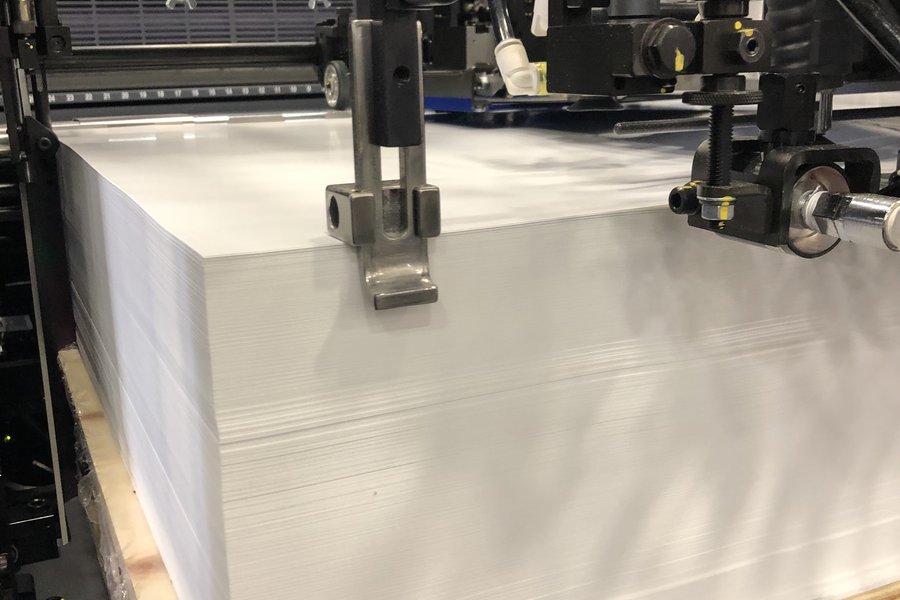
SBS is manufactured from bleached virgin wood fiber, giving the board a clean, consistent appearance throughout the sheet.
The controlled fiber furnish contributes to the uniformity and bright white appearance associated with SBS. This provides a strong foundation for printed packaging, displays, graphics and other applications where the appearance of the finished product matters.
Surface Smoothness Matters
One of the most important characteristics of SBS for printing is its smooth, consistent surface.
A smoother surface helps ink and coatings transfer more uniformly, supporting sharper detail, cleaner graphics and more consistent print reproduction.
Surface smoothness isn't simply about appearance. It is an important paperboard characteristic that can directly influence how the material performs during printing.
Coated SBS Creates an Enhanced Printing Surface
SBS can be manufactured with a coated surface to further improve smoothness and printability.
Depending on the grade and application, SBS may be available as coated one side (C1S) or coated two sides (C2S).
C1S can be appropriate when the primary graphics are on one side of the finished piece. C2S provides coated surfaces on both sides and can be useful when both sides will be visible or printed.
The appropriate construction depends on the printing process and the requirements of the finished application.
A White Surface Provides a Strong Base for Color
The bright white surface of SBS provides a clean background for printed graphics.
This is particularly valuable for applications involving brand colors, detailed graphics, photography and other design elements where color reproduction and presentation are important.
Rather than having to compensate for a grey or natural-colored substrate, printers begin with a consistent white surface.
Consistency Matters During Production
Successful printing requires more than a good-looking sheet.
Consistency in caliper, surface characteristics and sheet construction can help paperboard perform more predictably through printing and converting equipment.
This becomes increasingly important on production runs where consistent performance is required across hundreds or thousands of sheets.
When More Thickness Is Required
Some printed applications require substantially more thickness and rigidity than a standard single sheet can provide.
In these situations, multiple sheets of SBS can be laminated together to create a heavier finished board, like our Thru White, while maintaining the clean white surfaces and printing characteristics that make SBS desirable.
This can provide additional options for applications requiring both high-quality graphics and a more substantial board construction.
Where Is Printed SBS Used?
The combination of appearance, printability and structural performance makes SBS suitable for many applications, including:
- Packaging
- Folding cartons
- Point-of-purchase displays
- Signs and graphics
- Promotional materials
- Printed cards and panels
- Specialty converted products
The appropriate SBS grade, coating and caliper depend on the printing process and finished application.
Choosing the Right SBS
Print quality is only one consideration when specifying SBS.
Consider the printing method, finished size, required caliper, rigidity, surface requirements, whether one or both sides will be printed, and any laminating, die-cutting or other converting requirements.
Understanding the complete application makes it easier to select the appropriate board rather than choosing SBS based solely on thickness.
Lamitech supplies and converts Solid Bleached Sulphate paperboard for printing, packaging, display and specialty applications, including custom sizes and heavier laminated constructions.